What We Do
We make food-scrap recycling simple, professional, and cost-effective for every home. By collecting and transforming food waste into high-nutrient compost, we help restore soil health, improve water retention, support plant growth, and contribute to the healing of disturbed soils throughout our community. At Just Scrappin’, we’re not just collecting food scraps—we’re helping grow a better future.
Collect Your Food Scraps
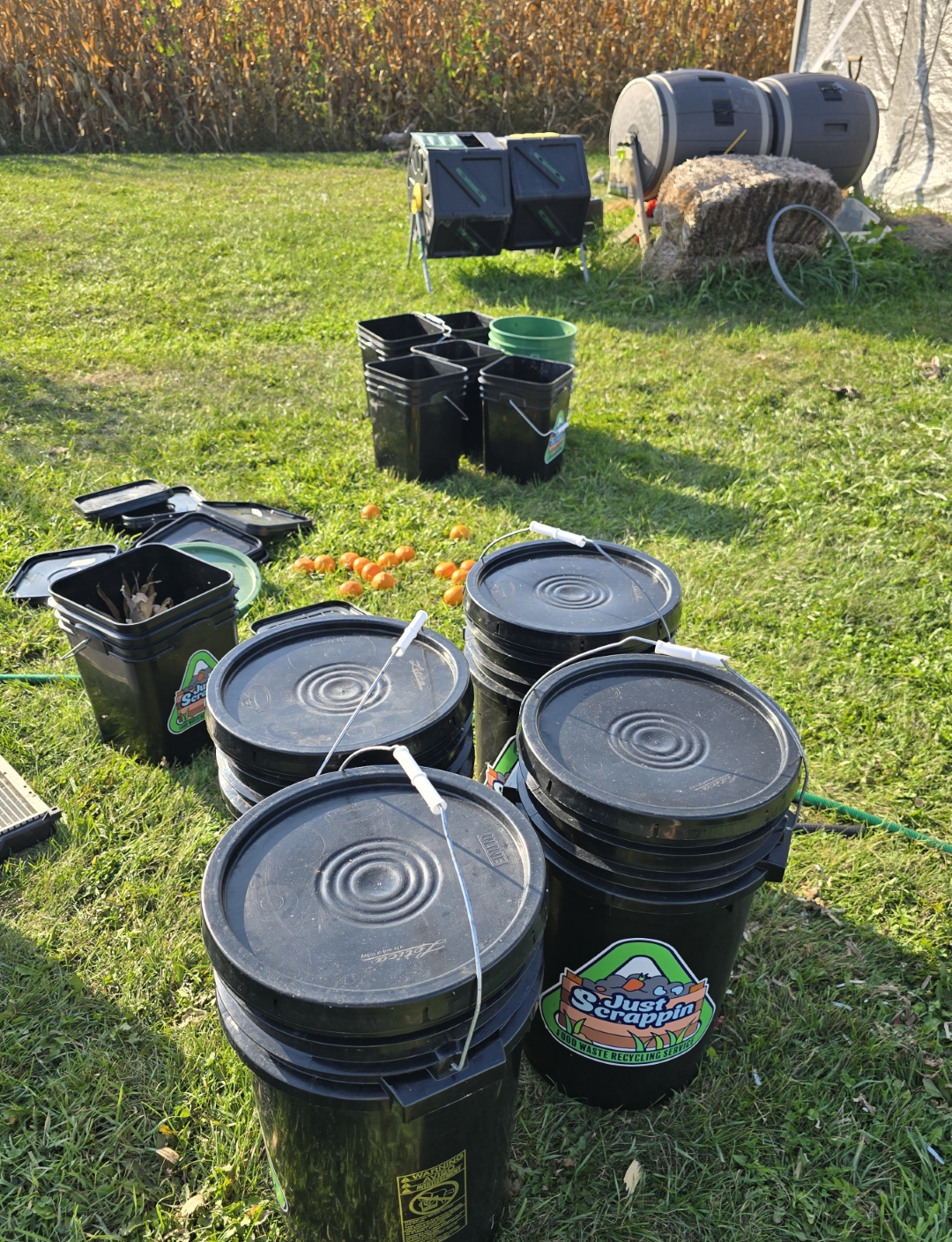
From fruit and vegetable peels to expired food, collect it in our buckets. You are provided with one or more 4 gallon buckets or larger as requested.
We Pick Up
Every other week, place your full bucket of food scraps by your doorstep or other convenient location. We pick up the full one and leave you with a clean, ready to fill bucket.
Help protect the environment
Composting helps the environment by reducing methane emissions from our already overflowing landfills. It also creates a nutrient-rich, biologically-stable soil amendment.
About Us
Just Scrappin’, started in June 2024, is a family-owned mother-and-daughter business built on a shared passion for sustainability, community, and caring for the world around us. Together, we are dedicated to creating a cleaner, greener future—one household, one bucket of food scraps, and one meaningful connection at a time.
Why Compost?
-
Reduces waste
-
Reduces methane emissions from landfills
-
Recovers organic materials and keeps them local
-
Extends municipal landfill life by diverting organic materials.
Pricing Plans
Our eco-friendly solutions help reduce landfill waste and promote sustainability. Contact us today to start composting!
Residential Membership
Door to door food waste recycling service. You fill the bucket, we pick it up. Together, We’re Just Scrappin’ the surface to reduce waste.
Commercial Membership
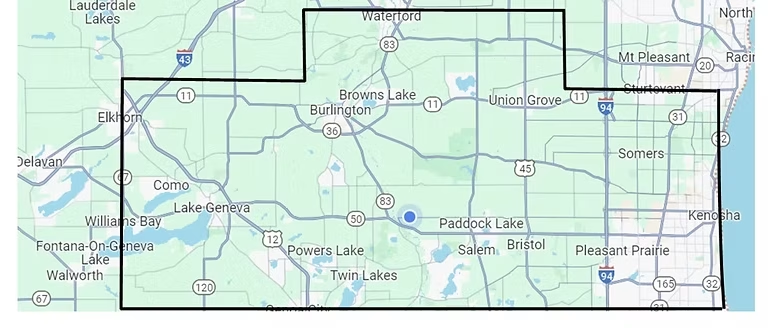
Service Area
The service area for Just Scrappin’ door to door pick ups is all of Kenosha County, Eastern Walworth County and Southwestern Racine County.
Why Recycle?
In 2020, an estimated 615,500 tons of wasted food scraps were disposed of in Wisconsin Landfills. This accounts for roughly 20.5% of waste that is added to our landfills every year.
Recycling provides many benefits to our environment. By recycling our materials, we create a healthier planet for ourselves and future generations.
Conserve natural resources: Recycling reduces the need to extract resources such as timber, water, and minerals for new products.
Climate change: According to the most recent EPA data, the recycling and composting of municipal solid waste (MSW or trash) saved over 193 million metric tons of carbon dioxide equivalent in 2018.
Energy savings: Recycling conserves energy. For example, recycling just 10 plastic bottles saves enough energy to power a laptop for more than 25 hours. To estimate how much energy you can save by recycling certain products, EPA developed the individual Waste Reduction Model (iWARM).
Waste and pollution reduction: Recycling diverts waste away from landfills and incinerators, which reduces the harmful effects of pollution and emissions.
On June 12, 2024, the White House, along with EPA, the U.S. Department of Agriculture, and the U.S. Food and Drug Administration released the “National Strategy for Reducing Food Loss and Waste and Recycling Organics.” This strategy is part of a series of strategies on building a more circular economy for all.
The goal of the strategy is to prevent the loss and waste of food and increase recycling of food and other organic materials, reduce greenhouse gas emissions, save households and businesses money, and build cleaner, healthier communities.
The four main objectives in the strategy are:
Objective 1: Prevent food loss.
Objective 2: Prevent food waste.
Objective 3: Increase the recycling rate for all organic waste.
Objective 4: Support policies that incentivize and encourage the prevention of food loss and waste and organics recycling.
Get Started Now!
Benefits of Compost Use
Composting is a controlled, aerobic (oxygen-required) process that converts organic materials into a nutrient-rich, biologically-stable soil amendment or mulch through natural decomposition. The end product is compost.
Stormwater Management
In the United States, our soils suffer from topsoil loss and erosion, which can lead to water quality issues and reduce the productivity of agricultural land. Compost adds much-needed organic matter to soil to enhance soil health. Compost has other uses as well in green infrastructure and stormwater management.
Climate Adaptation
When used efficiently, compost improves a community’s ability to adapt to adverse climate impacts by helping soil absorb water and prevent runoff of pollutants during floods. It also helps soil hold more water for longer, mitigating the effects of drought. It also strengthens sustainable, local food production by using locally generated food scraps and other organic materials to create a valuable soil amendment that supports plant growth.
Healthy Soil
Compost adds organic matter to the soil and increases the nutrient content and biodiversity of microbes in soil. It also improves plant growth and promotes higher yields of agricultural crops. In soil that has been depleted by overuse or contain contaminants, compost helps to regenerate and remediate (clean up).
In 2019, 66.2 million tons of wasted food were generated in the food retail, food service and residential sectors in the United States. Only 5% of that wasted food was composted.
In the U.S., food is the single most common material sent to landfills, comprising 24.1 percent of municipal solid waste. When yard trimmings, wood and paper/paperboard are added to food, these organic materials comprise 51.4 percent of municipal solid waste in landfills.
When food and other organic materials decompose in a landfill where anaerobic (without oxygen) conditions are present, bacteria break down the materials and generate methane, a powerful greenhouse gas. Municipal solid waste landfills are the third largest source of human-related methane emissions in the U.S, accounting for approximately 14% of methane emissions in 2021. Wasted food is responsible for 58% of landfill methane emissions.
When we send food and other organic materials to landfills or combustion facilities, we throw away the valuable nutrients and carbon contained in those materials. By composting our food scraps and yard trimmings instead and using the compost produced, we can return those nutrients and carbon to the soil to improve soil quality, support plant growth and build resilience in our local ecosystems and communities.
Gallery
Testimonials

Praesent gravida euismod scelerisque. Vestibulum consectetur vitae quam a varius. Praesent lacinia non nulla ac imperdiet. Pellentesque hendrerit felis at dui ornare, eget posuere nunc consequat.
Daniel Hoffman
Client

Phasellus et elit pulvinar, faucibus diam vitae, faucibus justo. Nunc mattis vitae quam id tempor. Lorem ipsum dolor sit amet, consectetur adipiscing elit. Sed a vehicula leo, in porta sem.
Josh Gears
Customer

Cras in posuere purus. Donec ac ornare enim, nec condimentum augue. Morbi ac tincidunt urna. Nullam hendrerit, dolor eu ullamcorper malesuada, lectus orci dictum arcu, vel sollicitudin nulla ex a metus. Cras consequat est vitae metus fringilla, eu placerat nunc faucibus.
Amanda Glipton
Client
Quisque id ullamcorper turpis, ac suscipit libero. Sed hendrerit rhoncus viverra. Ut id nisl purus. Suspendisse non rhoncus elit. Donec sit amet augue urna. Curabitur eu quam eu ipsum interdum mollis vel in metus. Pellentesque mollis porta augue condimentum aliquam. Cras id purus tortor.
Tessa Kamden
Customer
Mauris luctus massa enim, nec condimentum elit lacinia eget. Nam mollis leo a libero viverra, eget posuere elit hendrerit. Mauris sed risus sit amet lectus fringilla dapibus in in orci. Nullam ac elementum ex. Donec ac tristique urna.